Welcome to the digital age, where every website is a front door to your business. But what happens when that door is locked for millions of potential customers?
For too long, website accessibility—the practice of ensuring people with disabilities can perceive, understand, navigate, and interact with the web—was treated as a feature to be added later, or worse, an afterthought.
That era is over.
At WebWhizz, we believe that Accessibility-First Design is not merely a moral obligation; it is a critical component of modern web development, directly impacting your legal exposure, brand reputation, and most importantly, your search engine visibility.
If your goal is sustainable digital growth, making your site usable for everyone is now essential.
Beyond Ethics: Why Accessibility is a Hard Requirement
When we talk about accessibility (often abbreviated as A11y), we are talking about ensuring that people with visual, auditory, cognitive, and motor impairments can successfully use your platform.
While the ethical case for inclusion is clear, the pressing reality for business owners involves two primary, high-stakes factors: legal compliance and market performance.
The Legal Hammer: Understanding Digital Compliance
In many jurisdictions, websites and digital services are treated as "places of public accommodation." This means they must comply with existing disability laws.
The most prominent example in the United States is the Americans with Disabilities Act (ADA). While the ADA was written before the internet explosion, courts are increasingly applying its provisions (specifically Title III) to websites and mobile applications.
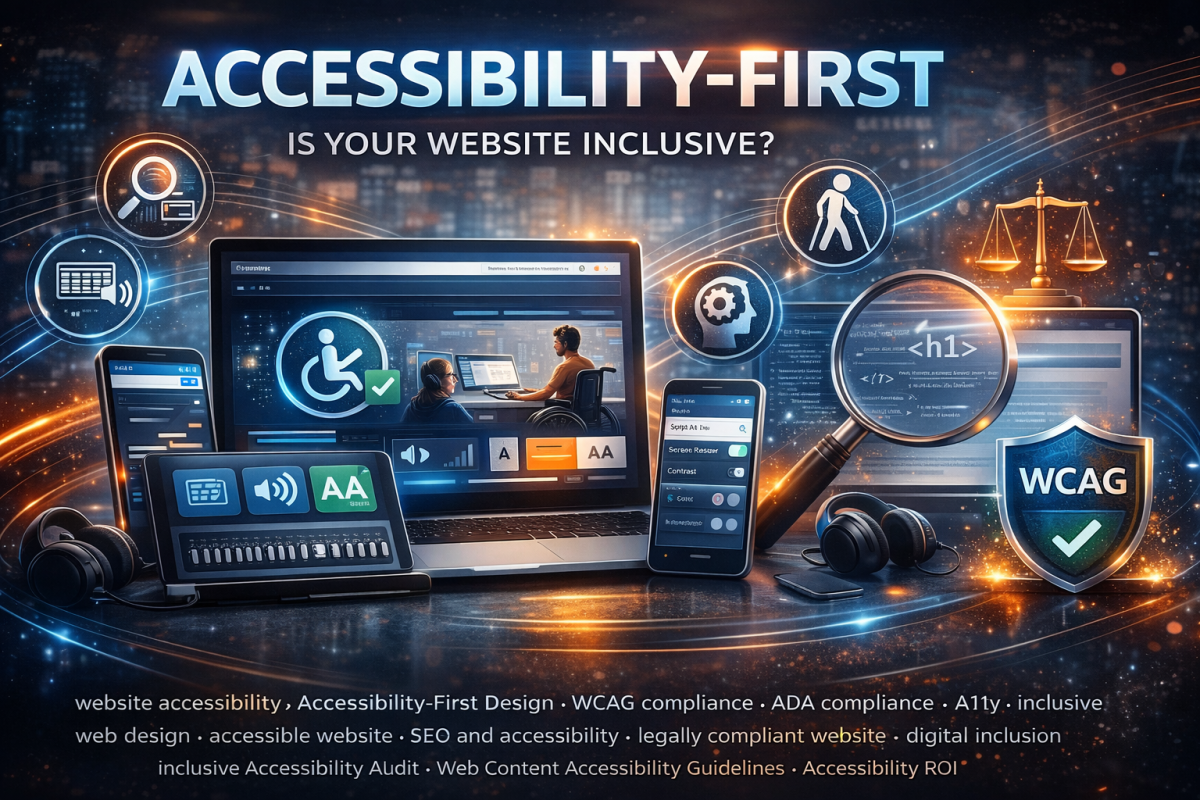
The practical standard courts rely on for determining digital compliance is the Web Content Accessibility Guidelines (WCAG), developed by the World Wide Web Consortium (W3C).
| WCAG Principle | What it Means for Your Site | | :--- | :--- | | Perceivable | Users must be able to recognize the content (e.g., proper contrast, alternative text for images). | | Operable | Users must be able to interact with all controls (e.g., full keyboard navigation). | | Understandable | Content and navigation must be predictable and clear. | | Robust | The site must work across different technologies, including various browsers and screen readers. |
The Risk of Non-Compliance
Ignoring these standards is a high-stakes gamble. Litigation regarding inaccessible websites has skyrocketed, leading to demand letters, costly settlements, and mandatory remediation—often resulting in a complete site overhaul under strict deadlines.
To mitigate this severe risk, proactive auditing is essential. At WebWhizz, we specialize in comprehensive WCAG 2.1 and 2.2 Level AA compliance audits as part of our core digital consulting services, ensuring your site is legally sound before the courtroom calls.
The SEO Superpower: Accessibility as a Ranking Factor
While lawsuits drive reactive change, smart business owners realize that accessibility is one of the most powerful, yet overlooked, SEO strategies available.
Google's primary goal is to provide the best possible experience for every user. When you build a site that is fully accessible, you are inherently building a site that is also easily readable and indexable by search engine bots.
How Google Rewards Usability and Semantic HTML
Many accessibility requirements align perfectly with Google’s Core Web Vitals and other ranking signals. When you optimize for A11y, you are optimizing for SEO.
Key A11y Features That Boost SEO:
- Semantic HTML: Screen readers rely on clear, semantic markup (e.g., using <h1>, <h2> for headings, <button> for buttons). Google's crawlers use this same structure to understand your content hierarchy and relevance. Proper semantic structure provides superior indexing compared to generic <div> tags.
- Alt Text and Image Descriptions: Providing descriptive alternative text for images (a critical component for visually impaired users) ensures that Google understands the context of your media, improving image search rankings and overall topical authority.
- Keyboard Navigation: A fully accessible site must be navigable using only the keyboard (essential for motor impairments). This necessity often leads developers to clean up messy code, resulting in better technical performance and faster load times—a major ranking boost.
- Clean Code and Performance: Building "accessibility-first" requires developers to focus on lean, well-structured codebases. This emphasis on technical excellence results in better site speed and stability, which Google heavily rewards.
By focusing on accessibility, you are fundamentally improving the machine-readability of your content. You are building a stronger, faster, and more trusted digital experience—precisely what search algorithms are designed to favor.
Implementing Accessibility-First: The WebWhizz Approach
Transitioning to an accessibility-first methodology requires shifting how your team thinks about design and development. It's not a patch you apply at launch; it’s the foundational layer of the build.
At WebWhizz Services, our accessibility integration covers everything from initial wireframes to final code deployment.
Practical Steps to Achieve WCAG Conformity
Whether you are building a new platform or remediating an existing one, these steps are crucial:
1. Audit and Strategy
Before any major changes, you need a clear picture of your current state. Our WebWhizz Digital Auditing process includes both automated scanning and expert manual reviews to identify compliance gaps quickly. We provide a prioritized roadmap for remediation.
- Key Focus: Identifying contrast issues, keyboard traps, and ambiguous link texts.
2. Design and User Experience (UX)
Accessibility starts with the visual design.
- Color Contrast: Ensuring text and background colors meet WCAG contrast ratios (Level AA). This is non-negotiable for low-vision users and also improves readability for everyone.
- Clear Focus Indicators: Providing highly visible outlines when a user tabs through the site, making it clear where they are on the page.
- Intuitive Hierarchy: Designing clear heading structures and consistent navigation patterns.
3. Development and Code Integrity
The most critical step involves the code itself, which is where our specialized WebWhizz Development Services shine. We ensure that every element is semantic and robust.
- Keyboard Accessibility: Ensuring all interactive elements (menus, forms, sliders) are fully operable without a mouse.
- ARIA Attributes: Utilizing Accessible Rich Internet Applications (ARIA) roles and attributes where native HTML is insufficient (e.g., complex widgets like modals or tab sets) to properly communicate state and function to screen readers.
- Form Labeling: Every input field must have an explicit, associated label, ensuring assistive technology users can complete forms reliably.
The ROI of Inclusive Design
The argument for accessibility boils down to clear return on investment (ROI).
By neglecting accessibility, you are effectively choosing to exclude approximately 15% of the global population from interacting with your site. That exclusion translates directly into lost market share.
- Increased Market Reach: Accessing the disability community and their buying power.
- Lower Legal Risk: Avoiding costly litigation and settlements.
- Superior SEO: Leveraging compliance features into high-ranking search visibility.
- Brand Reputation: Demonstrating commitment to corporate responsibility and inclusion.
Conclusion: Build Better, Not Just Faster
Accessibility-First Design is the future of the web. It is the framework that guarantees your digital assets are resilient against legal challenges and optimized for the constantly evolving requirements of search engines.
It’s time to stop treating accessibility as a checklist item and start treating it as the foundation of your digital strategy.
Ready to build a robust, legally compliant, and high-ranking website?
Contact WebWhizz Services today for a full accessibility audit and a customized remediation plan tailored to drive your digital growth.