In the digital world, speed isn't a luxury; it's the fundamental currency of customer experience. For too long, website performance has been relegated to the IT department—a technical detail managed by developers. But if you own an e-commerce platform or a lead-generation site, it’s time to reclassify speed.
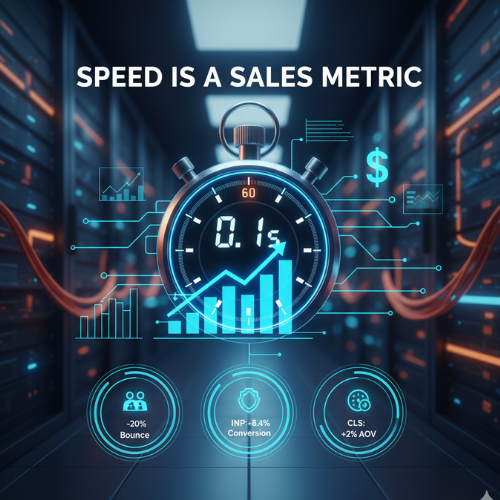
Speed is not a feature. It is a sales metric.
At WebWhizz, we understand that microseconds translate directly into thousands of dollars in revenue. If you want to outperform your competitors, you must stop viewing load time as a technical challenge and start viewing it as the single most critical bottleneck to your conversion rate.
This deep dive will show you precisely how every fraction of a second impacts your bottom line, and how optimizing that speed is the most powerful investment you can make in your business growth.
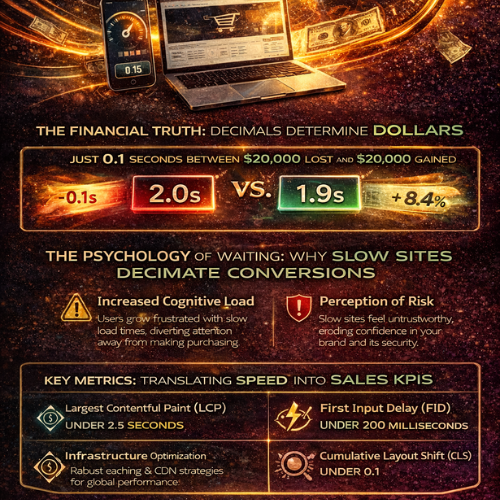
The Financial Truth: Decimals Determine Dollars
The difference between a 2.0-second load time and a 1.9-second load time may seem negligible to the untrained eye, but it is catastrophic in the conversion funnel.
Modern internet users are fiercely impatient. They demand instant gratification, and if your site doesn't deliver, they don't give you a second chance—they click the "back" button.
The 0.1 Second Effect: Quantifying the Loss
Research conducted by industry leaders like Google, Akamai, and Amazon has unequivocally proven a direct, linear relationship between load time and business results.
Consider these sobering facts based on aggregated industry data:
- For every 1-second delay in mobile load time, conversions can drop by an average of 20%.
- The first 5 seconds of page load time have the highest impact on conversion rates. As load time increases from 1 second to 5 seconds, the probability of a bounce increases by 90%.
- A mere 0.1-second improvement in load time can boost critical sales metrics:
- Mobile conversion rates can increase by up to 8.4%.
- Average Order Value (AOV) can improve by nearly 2%.
- Bounce rates can decrease significantly, freeing up your marketing budget to work harder.
If your site loads in 3.5 seconds and generates $50,000 in monthly revenue, speeding it up by just one second could realistically increase your revenue by $5,000 to $10,000 without acquiring a single new lead. Speed optimization is simply conversion rate optimization (CRO) by another name.
Why Slow Sites Decimate Conversions: The Psychology of Waiting
To understand the sales metric of speed, we must first understand the psychological process that causes a high bounce rate.
The Impatience Economy
We live in an "Impatience Economy." User expectations are set by giants like Netflix, Amazon, and Google, which deliver lightning-fast experiences. When your site doesn't match this benchmark, users subconsciously penalize you.
The moment a loading spinner appears, two negative processes begin:
- Increased Cognitive Load: The user is forced to wait, diverting their mental energy from evaluating your product/service to monitoring the load time. This frustration poisons the intent to purchase or inquire.
- Perception of Risk: A slow, clunky website often translates in the user's mind to an outdated, unprofessional, or potentially insecure operation. This erosion of trust is fatal for conversions, especially in e-commerce where credit card information is exchanged.
The Cost of Abandonment
Every time a user abandons your site due to slow loading, it represents more than just a missed sale—it represents wasted investment:
- Wasted Marketing Spend: You paid for that click (PPC, social media ads, SEO efforts). If the user leaves before seeing your value proposition, your Cost Per Acquisition (CPA) skyrockets.
- Negative Brand Association: Slow speeds create a negative impression that is difficult to reverse, potentially damaging long-term customer lifetime value (CLV).
- SEO Penalty: Google uses site speed and user experience metrics (like bounce rate and time on site) as critical ranking factors. A slow site gets demoted, leading to fewer organic leads and compounding the sales loss.
Key Metrics: Translating Speed into Sales KPIs
To effectively manage speed as a sales metric, you must look beyond generalized "load time" and focus on the technical performance indicators that Google defines as user experience benchmarks—Core Web Vitals (CWV).
These metrics are directly correlated with revenue performance:
1. Largest Contentful Paint (LCP)
LCP measures when the main content of the page has loaded and is visible to the user. This is the moment the user can actually see your product image, headline, or call-to-action (CTA).
- The Sales Link: If your LCP is poor (e.g., over 2.5 seconds), the user hasn't even had the chance to process your offer. Optimizing LCP means minimizing the time between the click and the sales pitch being delivered.
- Goal: Maintain an LCP under 2.5 seconds.
2. First Input Delay (FID) / Interaction to Next Paint (INP)
FID measures the responsiveness of your site—the time it takes for the browser to respond to a user’s first interaction (like clicking a button, tapping a navigation link, or filling a form field). (Note: FID is being replaced by INP, which measures overall responsiveness.)
- The Sales Link: A high FID/INP means that the CTA button the user just clicked seems non-responsive. This introduces friction right at the moment of conversion (checkout, sign-up, submission), often leading to frustrated double-clicks or abandonment.
- Goal: Maintain an INP under 200 milliseconds.
3. Cumulative Layout Shift (CLS)
CLS measures visual stability—how often elements on the page shift unexpectedly while loading. (Think of clicking a button, only to have an ad load and push that button out of the way.)
- The Sales Link: High CLS destroys user confidence and leads to misclicks, forcing users to start the process over. This is a massive conversion killer, particularly on mobile checkouts.
- Goal: Maintain a CLS score under 0.1.
Turning the Tables: How WebWhizz Maximizes Speed and Sales
Recognizing speed as a sales metric is the first step; taking action is the second. Many businesses try quick fixes (like image compression) but fail to address the underlying architectural issues.
At WebWhizz, our services are specifically designed to treat speed as the fundamental driver of conversion rate optimization. We don't just compress files; we architect performance into the core of your digital platform.
Our Strategy for Maximizing Your Speed ROI
- Deep Dive Diagnostics: We analyze your existing code, server architecture, and third-party scripts to pinpoint.
- Infrastructure Scaling & Optimization: We ensure your hosting environment is tailored for performance, implementing robust caching strategies and content delivery networks (CDNs) to reduce latency globally.
- Critical Path Optimization: We prioritize the loading of crucial elements (LCP content) over non-essential scripts, ensuring the user sees and can interact with your value proposition instantly.
- Code & Database Refinement: Our experts clean up bloated CSS/JavaScript and optimize database queries, drastically improving response times—the key ingredient for high FID/INP scores.
Are you ready to stop losing sales to poor performance? Let us help you turn those costly tenths of a second into profit.
Learn more about our comprehensive speed optimization and web development services designed for maximum conversion by visiting WebWhizz Services.
Conclusion: Stop Waiting and Start Converting
The relationship between speed and sales is no longer a theory; it is a proven law of the digital economy. Every 0.1 seconds your site stalls is time your competitor uses to capture your potential customer.
If you are pouring resources into marketing—PPC, SEO, and content creation—but ignoring site speed, you are effectively drilling holes in the bottom of your sales bucket. Speed optimization is the most efficient and scalable investment you can make, offering immediate and measurable improvements to your conversion rates, average order value, and overall revenue.
Treat speed like the valuable sales metric it is, and your website will finally deliver the performance—and profit—you’ve been aiming for.