Is your website “readable” by Alexa and Siri?
We live in a world where talking to our devices is as common as typing on them. From checking the weather on your smart speaker to navigating your commute using a voice assistant, conversational technology has fundamentally changed how we search for information.
But for businesses, this shift presents a massive question: Is your website optimized for the way people actually speak?
If your site isn't ready for natural, conversational queries, you are already missing out on a significant and growing percentage of traffic, visibility, and potential customers.
At webwhizz, we specialize in ensuring your digital presence is not just visible, but audible. This comprehensive guide breaks down exactly what voice search readiness means in 2024 and how our specialized services can bridge the gap between your website and the smart speakers in your customers’ homes.
The New Conversation: Why Voice Search Matters Now
Voice search is not a futuristic concept; it is the current reality. Unlike traditional desktop queries, which are often short, choppy, and keyword-focused ("best accountant NYC"), voice searches are typically longer, structured as full sentences, and centered around a direct question ("Hey Siri, who is the best accountant near me who specializes in small business tax?").
This distinction is crucial for one main reason: Voice assistants almost always provide only one result.
When a user types a query, they receive ten blue links. When they speak a query, the assistant (whether it’s Alexa, Siri, or Google Assistant) pulls one definitive answer, often sourced from Google’s Featured Snippet or Position Zero. If your content isn't structured to win that single coveted spot, you become invisible to the voice revolution.
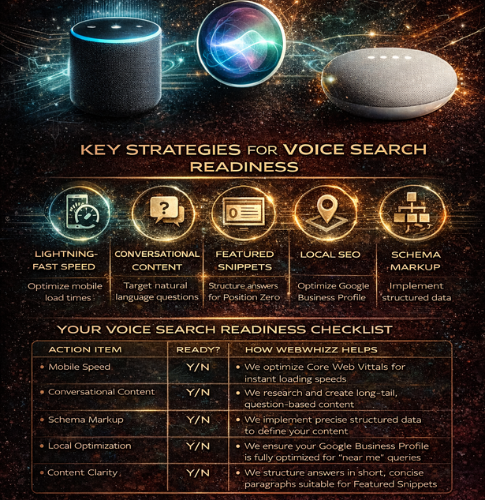
The 5 Pillars of Voice Search Readiness
Achieving voice search readiness requires a holistic approach that merges technical excellence with human-centric content strategy. Here are the five critical areas WebWhizz focuses on:
1. Speed is King (The Technical Foundation)
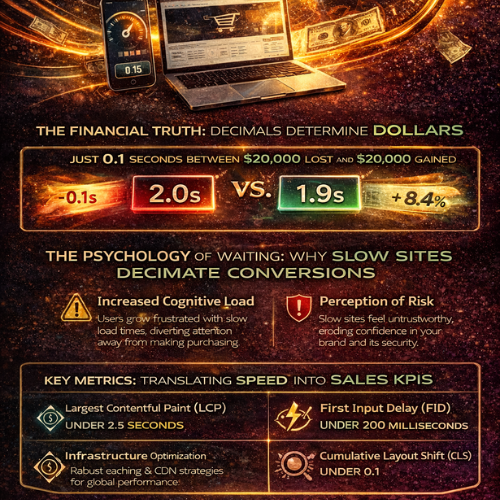
When we talk about voice search, speed isn't a luxury; it's a requirement. Voice assistants prioritize websites that load instantly because users expect immediate answers. A delay of even one second can cause the assistant to drop your site and move to a faster competitor.
Technical Checks Required for Voice:
· Mobile-First Indexing: Since most voice searches originate from mobile devices (smartphones) or devices with high sensitivity to speed (smart speakers), your site must be fully optimized for mobile.
· Core Web Vitals: We analyze and optimize key performance metrics like Largest Contentful Paint (LCP) and First Input Delay (FID) to ensure a lightning-fast user experience.
If your site feels sluggish, it won’t cut it for voice. Our Technical SEO Audit services are designed to rebuild your foundation for peak performance.
2. Mastering Conversational Keywords (The Content Shift)
The language we use when speaking differs significantly from the language we use when typing. Voice search demands a shift from focusing solely on head terms to prioritizing long-tail, natural language queries.
You must anticipate the questions your audience asks out loud.
| Typing Query | Voice Search Query | | :--- | :--- | | web design costs | How much does a professional website cost? | | 24-hour plumber | Is there a 24-hour plumber available right now? |
Our webwhizz content team dives deep into intent analysis, structuring content that directly answers these spoken questions using the 'who,' 'what,' 'where,' and 'how' framework. We build comprehensive FAQ sections and conversational content hubs that perfectly align with spoken user intent.
Learn how to talk directly to your audience’s smart speakers with our Content Marketing and Strategy services.
3. Claiming the Featured Snippet (Position Zero)
The Featured Snippet (or "Answer Box") is the short, highly relevant piece of text Google places at the very top of search results. In voice search, this snippet is almost always the chosen answer read back to the user.
To win this coveted "Position Zero," content must be:
- Concise and Direct: Answer the question immediately (in 40–60 words).
- Structured: Use clear headings (H2, H3), numbered lists, and tables to organize information, making it easy for the search engine to extract.
- Authoritative: Demonstrate clear expertise on the topic.
4. The Local Search Imperative
A vast percentage of voice searches have local intent, often driven by users on the go: "Alexa, find a coffee shop near me that's open."
If your business relies on foot traffic or servicing a local area, your Local SEO must be flawless for voice readiness. This involves far more than just having the right city in your title tag.
Key actions we take:
- Google Business Profile (GBP) Optimization: Ensuring your name, address, and phone number (NAP) are 100% accurate across the web. This is the primary data source for "near me" voice queries.
- Geo-specific Keyword Strategy: Optimizing content for hyper-local terms and neighborhood names.
- Consistency: Ensuring your hours, services, and location information are identical across every digital directory.
Make sure local voice assistants guide customers straight to your door. Explore our specialized Local SEO services.
5. Speaking the Language of Robots (Schema Markup)
While conversational keywords help humans understand your site, Schema Markup (Structured Data) helps search engine crawlers and voice assistants understand the context of your information.
Think of Schema as the universal translator of the internet. By adding invisible code to your website, you can tell Siri exactly what type of content you have:
- "This is a recipe."
- "This is our business’s official phone number."
- "This is a review rating."
- "This is a Frequently Asked Question (FAQ)."
Implementing the correct Schema is critical for voice, especially FAQ Schema and LocalBusiness Schema, as it dramatically increases the chance that your content will be extracted and read aloud accurately by an AI assistant.
Your Voice Search Readiness Checklist
Are you hitting the necessary markers to be heard by Alexa and Siri?
| Action Item | Ready? | How WebWhizz Helps | | :--- | :--- | :--- | | Mobile Speed | Y/N | We optimize Core Web Vitals for instant loading speeds. | | Conversational Content | Y/N | We research and create long-tail, question-based content. | | Schema Markup | Y/N | We implement precise structured data to define your content. | | Local Optimization | Y/N | We ensure your Google Business Profile is fully optimized for "near me" queries. | | Content Clarity | Y/N | We structure answers in short, concise paragraphs suitable for Featured Snippets. |
Don't Whisper, Be Heard: Partnering with webwhizz
Voice search is not the future of SEO—it is the present. Ignoring the shift toward conversational search means willingly handing market share over to competitors who are optimized for the way people actually engage with technology.
At webwhizzservices.com, our mission is to future-proof your digital strategy. We don't just chase algorithms; we optimize for human behavior, ensuring your business is ready to answer when the next voice query is spoken.
Ready to make your website audible to millions of smart device users?
Contact webwhizz today and let us help you achieve true Voice Search Readiness.