Launching an online store is exhilarating, but before you can start packing orders, you face the biggest decision: selecting the right platform. The e-commerce landscape is dominated by two giants, each offering a distinct path to digital success: Shopify and WooCommerce.
The question isn't which platform is objectively "better," but which is the best fit for your unique vision, budget, and technical comfort level.
At Webwhizz, we understand that this choice can be daunting. We specialize in building and optimizing professional e-commerce solutions, whether you prefer the managed ease of Shopify or the robust flexibility of WooCommerce. Our goal is to empower you with the facts so you can choose the engine that will truly propel your business forward.
Let’s dive into a comprehensive comparison of Shopify and WooCommerce.
A Snapshot Comparison
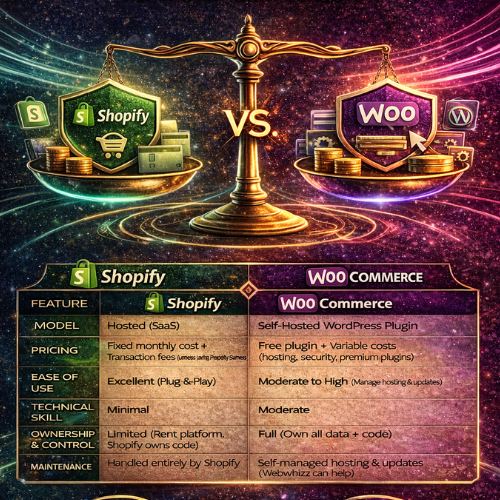
For those short on time, here is a quick overview of the core differences between the two platforms:
| Feature | Shopify | WooCommerce | | :--- | :--- | :--- | | Model | Hosted (SaaS – Software as a Service) | Self-Hosted (Open Source WordPress Plugin) | | Pricing | Fixed monthly subscription + Transaction fees (unless using Shopify Payments) | Free plugin + Variable costs (Hosting, Security, Premium Themes/Plugins) | | Ease of Use | Excellent. True plug-and-play setup. | Moderate to High. Requires management of hosting and software updates. | | Technical Skill | Minimal to none. | Moderate (Requires familiarity with WordPress and web hosting). | | Ownership/Control | Limited. You rent the software and platform. | Full. You own all your data and code. | | Maintenance | Handled entirely by Shopify. | Handled entirely by the store owner or developer (Webwhizz). |
Deep Dive: Shopify – The All-in-One Solution
Shopify is the reigning champion of simplicity. It operates on a Software-as-a-Service (SaaS) model, meaning it bundles everything you need—hosting, security, updates, and the platform software—into one monthly fee.
It is built specifically for e-commerce, making the initial setup incredibly straightforward, often allowing merchants to launch their store in a single day.
Pros and Cons of Shopify
Shopify Advantages
- Exceptional User Experience: The dashboard is intuitive, and adding products, managing inventory, and fulfilling orders is streamlined.
- Zero Maintenance: Shopify handles all technical upkeep, security patches, and server maintenance. You only worry about sales.
- Integrated Payments (Shopify Payments): Using their proprietary payment system removes external transaction fees (though standard credit card processing fees still apply).
- Fantastic Support: 24/7 customer support is available via phone, email, and live chat.
- App Store: A massive ecosystem of well-vetted, paid, and free apps to extend functionality.
Shopify Disadvantages
- Recurring Monthly Costs: The subscription fee is predictable but mandatory, even during slow months.
- Transaction Fees: If you use a third-party payment gateway (like PayPal or Stripe), Shopify charges an additional 0.5% to 2.0% fee on top of the gateway fee.
- Limited Deep Customization: While themes are flexible, customization requiring deep code changes can be restricted by Shopify's platform structure.
- High App Dependency: Essential features often require paid monthly apps, leading to higher recurring costs.
Who is Shopify Best For?
Shopify is ideal for new merchants, small businesses, and those who prioritize ease of use and speed over technical customization. If you are not technically inclined and want a solution that simply works out of the box, Shopify is the clear winner.
Deep Dive: WooCommerce – Flexibility and Ownership
WooCommerce is not a standalone platform; it is a free, open-source plugin built for WordPress, the most popular content management system (CMS) in the world. This symbiotic relationship provides unparalleled flexibility and control, as it leverages WordPress’s massive ecosystem.
While the plugin itself is free, WooCommerce stores are self-hosted, meaning you are responsible for hosting, security, backups, and maintenance.
Pros and Cons of WooCommerce
WooCommerce Advantages
- Total Ownership and Control: You own 100% of your data and code. There are no restrictions on how you modify the platform.
- Cost-Effective Entry: The plugin is free. Initial costs are limited to hosting, a domain, and potentially a premium theme.
- Unlimited Customization: Because it is open-source, if you can dream it, a developer (like the experts at Webwhizz) can build it using custom code.
- No Transaction Fees: You only pay the standard processing fees charged by your chosen payment gateway (e.g., Stripe, PayPal).
- SEO Power: Built on WordPress, the platform is inherently excellent for Search Engine Optimization.
WooCommerce Disadvantages
- Steeper Learning Curve: Managing hosting, security, updates, and conflicting plugins requires technical proficiency.
- Hidden Costs: While the plugin is free, costs rapidly accumulate for quality hosting, security features, and essential premium plugins (like advanced shipping or subscriptions).
- Self-Managed Security: You are responsible for ensuring your site is secure, backed up, and compliant.
- Support: Support is decentralized. You rely on community forums, the plugin developer, or external development agencies for help.
Who is WooCommerce Best For?
WooCommerce is the perfect solution for established businesses, developers, large stores with complex needs, and merchants who need deep integration with existing WordPress content. If you have the budget for professional development and maintenance, or have the technical skills in-house, WooCommerce offers limitless scaling potential.
Head-to-Head Comparison: The Critical Metrics
When making your final choice, these four metrics often decide the winner.
1. Cost and Pricing Structure
The biggest pricing difference is predictability versus flexibility.
| Cost Factor | Shopify | WooCommerce | | :--- | :--- | :--- | | Monthly Fees | Starts at $29/month. Mandatory, fixed cost. | Free plugin. Cost is determined by hosting (starts low, scales up quickly). | | Transaction Fees | Yes (if not using Shopify Payments). | No (only standard processor fees apply). | | Apps/Plugins | Often monthly subscriptions; generally high quality. | Mix of one-time purchase and monthly subscriptions; requires careful vetting. | | Development | Higher per-hour rate for custom Liquid code adjustments. | Standard developer rates for PHP/WordPress; cheaper for extensive work. |
2. Technical Skill and Maintenance
If you hate troubleshooting, hosting, and security protocols, the choice is simple.
- Shopify: Requires virtually zero technical skill. You click a button, and it works. Maintenance is non-existent for the merchant.
- WooCommerce: Requires moderate to advanced technical skill. You must manage core WordPress updates, plugin updates, server security, caching, and database optimization. This complexity is why many clients partner with Webwhizz—to outsource the burden of constant maintenance.
3. Scalability
Both platforms can handle massive traffic, but they approach scalability differently.
- Shopify: Excellent scalability. As a hosted solution, they manage the infrastructure automatically. Scaling up simply means upgrading your plan. It is reliable for handling flash sales and seasonal spikes.
- WooCommerce: Highly scalable, but requires proactive infrastructure management. You must invest in robust, managed hosting (like WP Engine or Kinsta) and potentially a Content Delivery Network (CDN) to ensure performance under heavy load. The potential is limitless, but the infrastructure burden is yours.
4. Customization and Design
Customization is often the deciding factor for complex businesses.
- WooCommerce (WordPress): Unrivaled. Because it is open-source, you can modify any aspect of the front-end design or back-end functionality. If your business model requires complex, unique features (e.g., highly specific product builders, unusual subscription tiers, or specific B2B pricing logic), WooCommerce provides the freedom needed.
- Shopify: Excellent for design customization through themes and the visual editor. However, deep customization of the checkout process or highly specialized data handling is restricted by Shopify's core code (written in Liquid).
The Webwhizz Verdict: How to Choose Your Champion
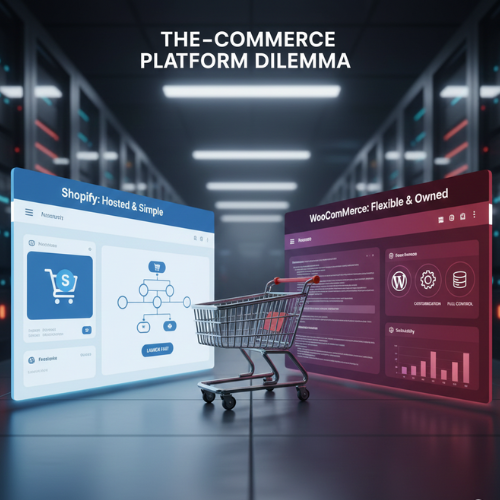
Ultimately, the choice between Shopify and WooCommerce is a strategic business decision based on your long-term goals.
Choose Shopify If:
- You are selling physical products and want to launch fast.
- Your budget prioritizes predictable operating costs over deep customization.
- You want an easy-to-use system with guaranteed 24/7 technical support.
Choose WooCommerce If:
- You already use WordPress or need a highly integrated CMS/e-commerce solution.
- You require highly specific, complex, or bespoke functionality (B2B features, custom product configuration).
- You prefer owning your platform and data, and you are ready to invest in expert development and maintenance.
Let Webwhizz Guide Your Launch
Whether you need the streamlined efficiency of a Shopify storefront or the robust, custom-built power of a fully optimized WooCommerce environment, Webwhizz is here to help.
We don't just set up templates; we design, develop, and optimize e-commerce platforms that are tailored to convert. From high-speed hosting solutions for WooCommerce to custom theme development on Shopify, we ensure your chosen platform performs flawlessly.
To learn more about our development philosophy and how we help businesses thrive online, please check out our About Us page.