The digital marketing landscape is undergoing its most profound transformation in decades. The slow, painful deprecation of third-party cookies, coupled with rapidly evolving global privacy legislation (GDPR, CCPA), has forced businesses into a critical strategic pivot.
The old era of broad, often intrusive, third-party tracking is over. The new era is built on consent, transparency, and high-quality, owned data.
For businesses aiming not just to survive but thrive, this shift requires mastering Privacy-First Marketing and elevating First-Party Data (FPD) to the gold standard.
The New Reality: Why Third-Party Cookies Are Obsolete
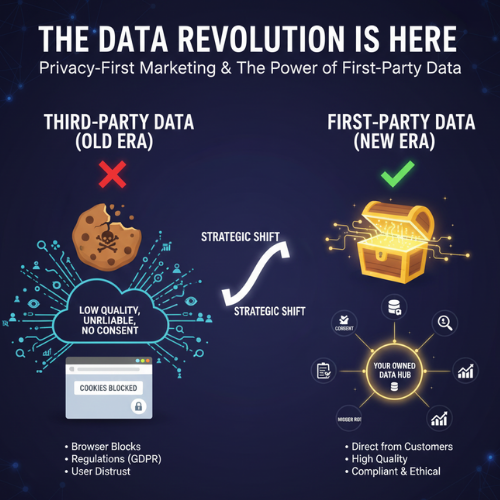
For years, marketers relied on third-party cookies—tiny snippets of code dropped by external domains—to track users across different websites, build massive behavioral profiles, and enable retargeting.
Today, this model is fundamentally broken:
- Browser Restrictions: Major browsers (Safari, Firefox, and increasingly Chrome) are blocking or severely restricting third-party tracking by default.
- Regulatory Pressure: Consumers are protected by stricter laws, making non-consensual tracking a legal liability.
- Consumer Expectations: Users are increasingly privacy-savvy and actively demand transparency in how their data is used.
The result is a major loss of signal for traditional targeting and measurement tools. The only reliable solution is to control the data flow entirely—by collecting it directly.
Understanding the Gold Standard: First-Party Data (FPD)
First-Party Data is information a company collects directly from its customers through owned channels. Crucially, the customer knows they are providing the data, and the data is stored and utilized solely by the brand that collected it.
The Power of FPD
In the post-cookie world, FPD offers unmatched advantages:
- Accuracy and Quality: It is pristine, real-time data collected at the point of interaction (e.g., a purchase, a sign-up, or a website preference update).
- Compliance: Because it is collected with explicit or implied consent directly from the user on your domain, it inherently supports most major privacy frameworks.
- Higher ROI: FPD allows for highly effective personalization, leading to better segmentation, higher conversion rates, and increased Customer Lifetime Value (CLV).
- Ownership and Control: You own this data outright, safeguarding your marketing intelligence from external platform changes.
Strategies for Ethical First-Party Data Collection
Moving to a privacy-first model is not just a technical change; it's a strategic shift requiring innovation at every customer touchpoint.
At WebWhizz, we help businesses structure their infrastructure to maximize ethical FPD capture and usage. Here are the core strategic pillars:
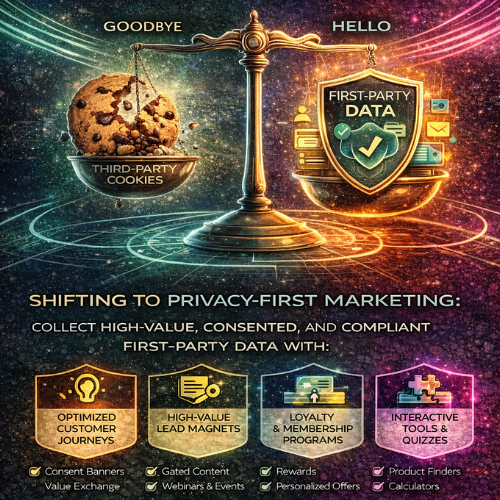
1. Optimize Your Customer Experience (CX) Touchpoints
The best way to get data is to ask for it politely, explaining the value in return. The goal is to move passive visitors into known, consented users.
- Consent Management Platforms (CMPs): Implement clear, compliant consent banners and preference centers that allow users to easily opt-in or out, ensuring you adhere to local regulations.
- Value Exchange: Instead of demanding a massive sign-up form, offer progressive profiling. Ask for an email address in exchange for an immediate benefit (e.g., a 10% discount) and then collect more detailed demographic data later in the customer journey.
2. Leverage High-Value Content and Gated Assets
Content remains one of the most powerful FPD collection tools. If the value of the content is high enough, the exchange for an email address or basic profile information becomes worthwhile for the consumer.
- Lead Magnets: Offer downloadable industry reports, comprehensive guides, or competitive analyses (e.g., "The 2024 State of E-commerce Report") behind a simple registration form.
- Webinars and Virtual Events: These require an email sign-up and often provide opportunities to collect deeper professional data (job title, company size) during registration.
3. Build Robust Loyalty and Membership Programs
Subscription and loyalty programs are the bedrock of sustainable FPD strategy. They incentivize customers to actively share data about their preferences, purchase history, and lifestyle in exchange for rewards, early access, or exclusive content.
The data gathered here (e.g., "Favorite product type," "Desired shipping speed") allows for hyper-segmentation that third-party data could never provide.
4. Implement Interactive and Data-Gathering Tools
Static forms are dull. Interactive tools make data collection fun and useful for the customer.
- Quizzes and Product Finders: An interactive quiz like "Find Your Perfect Running Shoe" collects explicit preference data while simultaneously guiding the customer toward a purchase.
- Calculators and Configurators: Tools that help a customer solve a problem (e.g., "Estimate Your Website Development Cost") require input fields that translate directly into valuable intent data.
The Technical Infrastructure: Moving Beyond the Browser
Collecting FPD is only half the battle. To be useful, it must be centralized, cleaned, and activated across all marketing channels. This requires a robust technical foundation—expertise that is core to what we do at WebWhizz.
Centralizing Data with a Customer Data Platform (CDP)
The key component of a modern privacy-first stack is the Customer Data Platform (CDP). A CDP ingests all your FPD—from your website, CRM, POS systems, and service desks—and creates a single, unified customer profile.
This unification allows you to:
- Activate Data: Use the same behavioral insights to personalize email, tailor website content, and create lookalike audiences for paid media (even without third-party cookies).
- Manage Consent: Apply consent flags uniformly across all systems, ensuring you never message a customer who has opted out.
Enhancing Data Quality with Server-Side Tagging (SST)
Traditional tracking relies on client-side tracking (browser tags), which are easily blocked by modern browsers and ad-blockers, leading to data loss.
Server-Side Tracking (SST) moves the processing of data away from the user’s browser and onto a secure server you control. This significantly improves data quality and reliability while offering enhanced privacy control, as less data is exposed to the user’s device.
Need help structuring your data infrastructure, integrating a CDP, or migrating to Server-Side Tracking? Learn about our comprehensive Data Strategy and Analytics services at WebWhizz Services.
Moving Forward: Marketing Built on Trust
The shift to Privacy-First Marketing is not a punitive measure; it is an opportunity. It forces businesses to move away from low-quality, high-volume data streams towards high-quality, high-trust relationships.
When customers willingly provide their data because they trust your brand and understand the reciprocal value, the data you collect is exponentially more powerful. This trust translates directly into loyalty, retention, and ultimately, greater profitability.
The future of marketing belongs to those who prioritize consumer consent and transparency. It’s time to stop chasing fleeting third-party signals and start cultivating your own rich garden of First-Party Data.
Are You Ready for the Privacy Revolution?
The post-cookie era is here, and waiting is no longer an option. Future-proofing your marketing means adopting technologies and strategies that center around the customer experience and ethical data collection.
If your current analytics setup relies heavily on outdated tracking methods, or if your First-Party Data sits siloed across multiple systems, it’s time for an audit.
The team at WebWhizz specializes in helping businesses navigate this transition, implementing robust data architecture and defining clear FPD strategies that drive compliance and results.
Ready to audit your current analytics setup and build a resilient data strategy? Contact the WebWhizz team today and let’s make your marketing intelligence unstoppable.